
Handwoven Banarasi sarees from Banaras — real woven zari, not foil print.
In Chiniya silk, cotton and featherweight Kota.
Shop by Category
Latest Arrivals


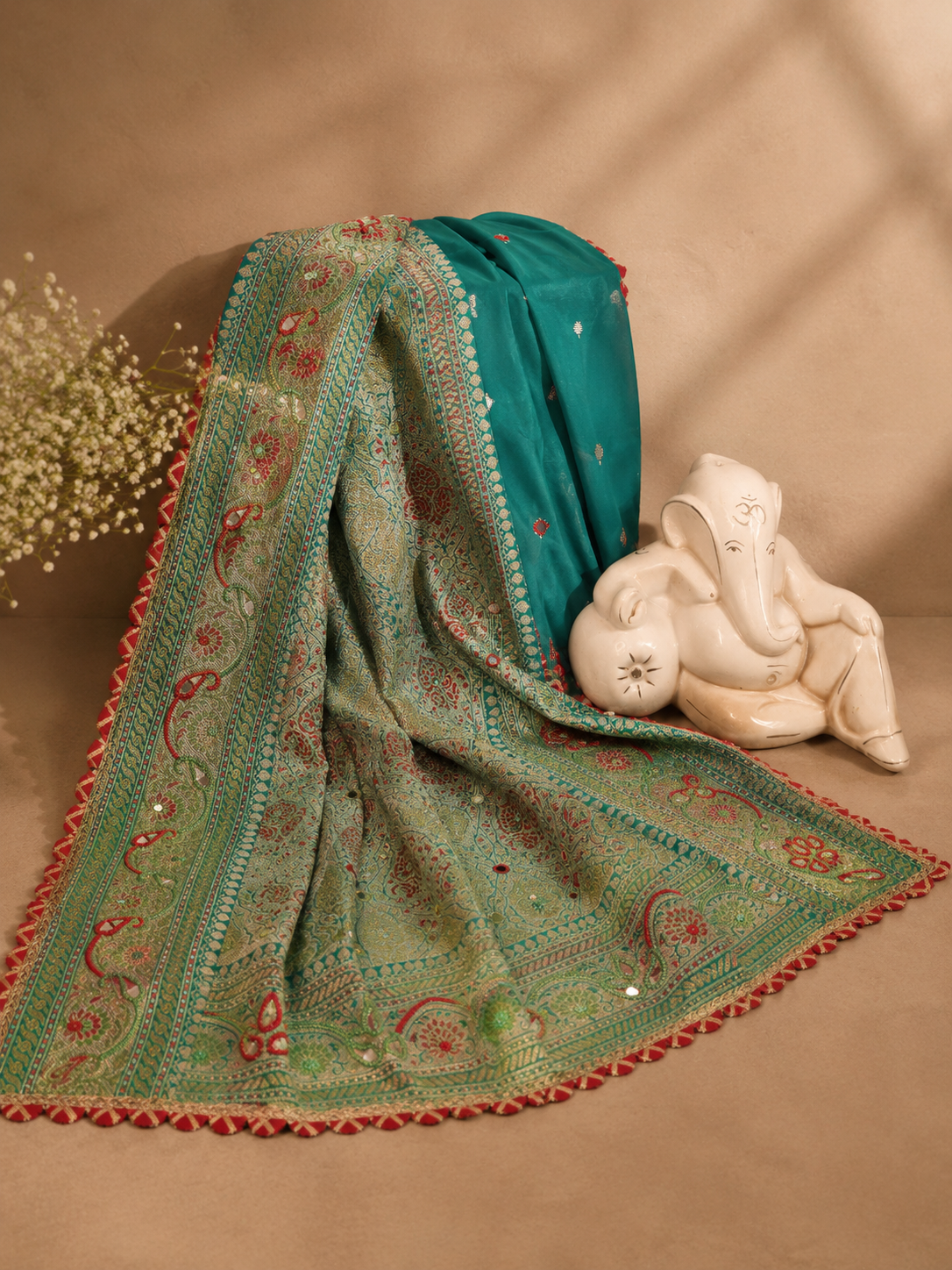
Banarasi Sarees
Banaras has been weaving silk for something close to five hundred years, and in that time the city has produced not one saree but a whole family of them. What unites them is not a single fabric or a single motif but a technique — supplementary weft weaving, in which extra threads of silk or zari are introduced across the base cloth to build the pattern as the saree grows on the loom.
The Banarasi family
Most people picture a heavy Katan silk when they hear the word, but the range is much wider:
- Kota Banarasi — featherweight Kota Doria cotton from Rajasthan, with zari laid in by Banarasi weavers. The lightest way to wear the craft.
- Chiniya silk — a soft-sheen plain silk with a fluid drape, often woven with minimal ornament.
- Cotton Banarasi — the same weaving vocabulary on a cotton base. Breathable, everyday, still ornamented.
- Organza and tissue Banarasi — sheer bases with dense zari, cut for evening.
How to tell a handwoven Banarasi from a powerloom copy
This is the single most useful thing to know when buying online, because the price gap between the two is enormous.
- Turn it over. On a handwoven saree the reverse of the motif shows loose floating threads where the extra weft crosses between motifs. Powerloom pieces are cut clean or backed.
- Look for the weaver's small asymmetries. Motifs on a handloom saree vary very slightly in spacing. Machine repeats are exact.
- Check the zari. Real zari is silk thread wrapped in flattened metal. It has depth and slight tonal variation. Plastic zari is flat, uniformly bright, and feels sharper.
- Feel the weight distribution. Handwoven pieces are denser at the pallu and border where the work is concentrated.
When to wear it
The lighter Banarasis — Kota, cotton, plain Chiniya — are day-to-evening sarees that work at a puja, a daytime function, or a workplace celebration. The heavier silk pieces are for weddings, receptions and the occasions where you want the saree itself to be the statement. In both cases the rule is the same: let the weave do the work, and keep the blouse and jewellery quieter than the saree.
Care
Dry clean only for anything with zari. Water tarnishes metallic thread and there is no reversing it. Iron on low with a cloth between the iron and the zari. Store folded in cotton or muslin, never plastic, and refold along a different line every few months — zari cracks along a permanent crease. Keep silica or neem leaves in the fold rather than naphthalene.
Our Banarasi collection
Sourced directly from weavers in Banaras. Each piece is one of a kind. Supplied as the drape, to be tailored to your own measurements. Free shipping across India, 7-day exchange.

